The Three Losing Options Every CMO Knows Too Well

Good, fast, cheap: pick two. It's the oldest constraint in creative services, and for decades it's functioned less like a rule and more like a disclaimer, something agencies say before they tell you what you're not getting. The industry has treated it as gravity. A law rather than a problem to solve. It isn't.
But the cost of accepting it keeps going up. Gartner's 2026 CMO Spend Survey, released in May, found that 56% of CMOs say their marketing organization lacks the budget required to deliver their 2026 strategy. Marketing budgets sit at 7.8% of company revenue, barely moved from 7.7% the year before. Meanwhile, CMOs are allocating an average of 15.3% of those budgets to AI initiatives, even as only 30% report mature readiness to scale them.¹
Read that again. CMOs are being asked to deliver an AI transformation, growth, and efficiency without a meaningful budget increase. The constraint is tightening. The old disclaimer is getting more expensive by the quarter. And the agencies repeating it are running out of time to offer something better.
The three losing options
Walk into any agency pitch today and you'll hear about partnerships, creativity, and investment. What you'll hear less about is the structural limitation baked into every model on the table.
Tier 1 — Premium consultancies IDEO, Red Antler, Pentagram. These are the archetypal premium branding agencies. The work is exceptional, showcasing craft and strategy at genuine elevation. The pace and price tag are designed for the few brands that can afford both.
Tier 2 — Offshore hybrid shops Superside, Dept, Breef. Fast turnaround, accessible economics, real throughput. Speed often comes at the cost of taste, and the brand doesn't always survive the volume.
Tier 3 — DIY tools Air, Brand AI, Agentio. The infrastructure is there. CMOs get access on demand. The expertise lives somewhere else. A platform without a creative team is expensive software.
Every buying decision forces a CMO into one of these corners. Budget cycles become an exercise in rationing. This quarter, speed matters, so quality gets sacrificed. Next quarter, a brand moment arrives, so the timeline slows and the invoice doubles. The trade-off feels permanent because the structure that produces it has been permanent.
AI changed the math, but most creative agencies haven't
The conventional wisdom says AI will fix this. Layer generative tools onto existing workflows, and agencies will deliver faster, cheaper, and better at the same time. The reality is more complicated.
A Gartner survey conducted in early 2025 found that 22% of CMOs said generative AI had already reduced their reliance on external creative agencies for creativity and strategy.² A more recent assessment from Digiday quoted Gartner's Jay Wilson directly: “The honeymoon around AI and agencies is essentially over.” CMOs reviewing scopes of work in 2026 aren't seeing the cost savings their agencies promised a year ago.³
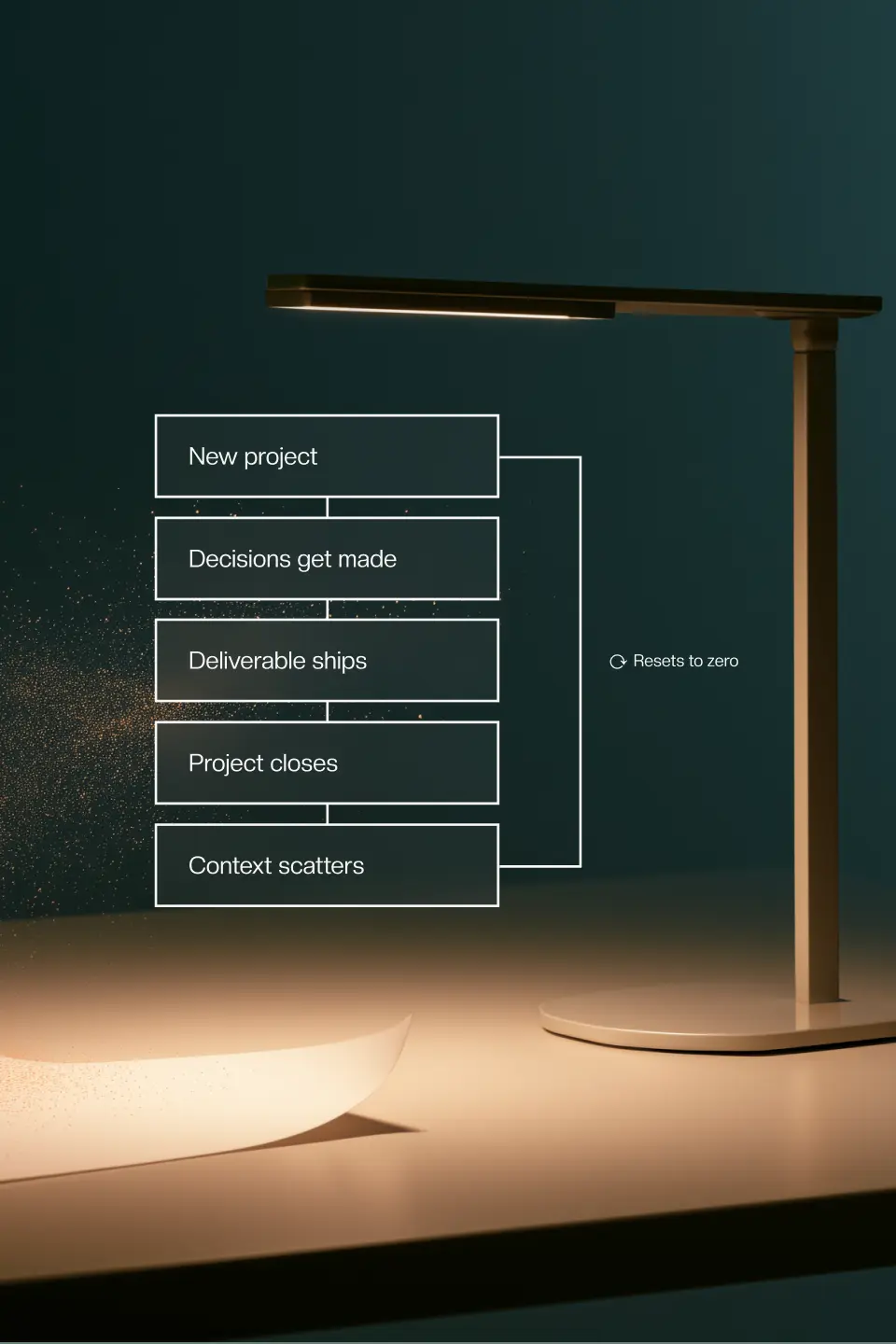
Most agencies have adopted AI the way they've adopted every previous tool: bolted on top of the existing structure. An account team still runs the relationship. A project manager still owns the brief. A creative director still approves the output. AI speeds up some steps in the middle, but the architecture remains unchanged. So do the costs.
The agencies that will matter in five years are the ones rebuilding the stack around AI, replacing the account-team layer with an intelligent system that lets clients work directly with the creative work, not around it.

What a new model actually looks like
Radiance was built on the belief that the triple constraint is a structural problem, not a permanent one. The category distinction between “agency” and “tool” is itself part of what produces the trade-off. Treat them as separate, and a brand has to choose. Combine them into a single operating model, and the choice disappears.
The premise is straightforward. Premium creative direction when a brand needs it, built on an AI-native platform that manages the in-between (the coordination, the context, the continuity), so nothing falls through the cracks and no one wastes time filling them. Direct access to the creative system through the tools brand and product teams already live in, including Slack, Jira, and Figma. The connective tissue underneath all of it is The Source®, Radiance's proprietary creative OS. The Source® holds a brand's strategy, voice, visual identity, and history as a living context that learns with every asset, brief, and decision. Premium quality at the top of the funnel, AI-native execution at the bottom, and a single system that keeps them coherent throughout. That is brand management built for how brands actually operate today: one system holding identity, execution, and strategy together instead of three vendors handling each in isolation.
Learn more about how The Source® works here.
The question CMOs should be asking
With AI investment rising and budgets refusing to follow, the conversation about agency value is happening at every brand whether or not there's an obvious answer yet. The instinct is to consolidate. Fewer relationships, tighter scopes, renegotiated contracts.
That's rational. It's also defensive. The harder question worth asking is whether the agency category itself, as currently defined, is the right frame. If what a CMO actually needs is high-quality creative output, fast when speed matters and considered when it doesn't, embedded in the systems their team already uses, that need isn't a brief for an agency. It isn't a brief for software either. It's a brief for a new category.
The trade-off between great creative and fast creative was never a law of physics. It was a product of how agencies were organized before AI made a different organization possible. The brands that figure that out first will have a meaningful head start.
Sources:
¹ Gartner, “Gartner 2026 CMO Spend Survey Finds CMOs Allocate 15.3% of Marketing Budgets to AI, But Only 30% Are Ready to Scale AI Capabilities,” May 11, 2026. Survey of 401 CMOs across North America, the UK, and Europe, conducted January–March 2026.
² Gartner CMO Spend Survey, 2025 (cited in Campaign US, “How CMOs are rethinking teams, tools, agencies with AI,” July 2025).
³ Digiday+ Research, “Agencies punt budget growth expectations to 2027 — while AI worries intensify,” April 2026.

(00)
bright insights
(Bright Insights)