The Feedback Loop: Humans Improving AI Outputs

Most AI systems treat human feedback as a one-way street: humans correct mistakes, and that’s the end of it. But sophisticated human-in-the-loop systems create a virtuous cycle where every correction, edit, and refinement makes the AI more aligned with human judgment over time. This is where the real power emerges, with AI that becomes increasingly collaborative rather than just assistive.
Why most AI tools don’t actually improve from your use
You’ve corrected the same AI mistake three times this week. You change the output, move on, and hope that next time will be different. It isn’t. And almost imperceptibly, you start trusting the system a little less each time.
This is the experience of most AI tools today. The human is in the loop only in the most superficial sense. We’re present enough to catch errors, but not empowered to actually change them. What looks like a collaborative system is really just very fast autocomplete with a QA team attached.
It doesn’t have to work this way.
Not all feedback is created equal
The first step toward a real feedback loop is recognizing that human corrections aren’t a single undifferentiated signal. There’s a rich taxonomy of how humans interact with AI outputs and each type tells you something different about what the system actually needs to learn.
Direct corrections: changing specific outputs, signaling that something was wrong.
Contextual overrides: consistently changing outputs in specific situations, revealing something deeper: a systematic misalignment between how the AI has modeled your context and how your context actually works.
Implicit feedback: what you keep versus delete, how long you spend reviewing, how many times you regenerate before accepting, carrying enormous information even when you never mark anything as wrong.
The hardest distinction any AI system has to make is between “this output was wrong,” “this output was right but not what I needed right now,” and “this output would be right for most people, but not for me.” Conflating these is how systems learn the wrong lessons from perfectly good feedback.
The signal-versus-noise problem
Collecting corrections is easy. Interpreting them correctly is where most systems fail.
Sometimes users “correct” things that aren’t actually wrong, they’re just stylistically different. If a system learns too eagerly from this, it stops being accurate and starts being a mirror, optimizing for familiarity over quality. There’s also context dependence: a correction that makes sense in one situation might be wrong in another, and learning from a single instance without understanding the surrounding context risks overfitting. And there’s the silent failure problem; users accepting imperfect outputs because editing is harder than moving on.
Absence of correction does not mean correctness.
The best systems hold their inferences lightly, triangulate across many signals, and flag uncertainty when a pattern doesn’t fully cohere.

Designing for quality feedback
The interface choices an AI product makes directly determine the quality of the learning signal it receives. If it’s faster to delete an output and start over than to mark what’s wrong with it, that’s what users do…and thus the most valuable training data disappears.
This points toward a few principles of AI design: low-friction correction mechanisms, granular feedback that lets users mark specific parts of an output rather than reacting to it all-or-nothing, and most powerfully, explanation capture.
“This format is wrong” is useful. “This format is wrong for external documents, but fine for internal ones” is transformative. It turns a correction into a rule. And rules generalize in ways that single-instance corrections cannot.
How learning actually happens
The most sophisticated systems layer learning across timescales. Some corrections take effect immediately, updating an explicit preference, locking a specific convention. Others feed into longer calibration cycles, where signals are cross-referenced and validated before changing anything broadly. Users experience responsiveness. The system maintains robustness. These aren’t competing goals, they just operate at different levels.
There’s also the individual-versus-collective question. When a correction reveals a genuine error, it should propagate broadly. When it reflects personal style, it should stay personal. A system that can’t tell the difference will either be too rigid or too eager to generalize; and either way, it stops feeling like it knows you.
Three moments where the loop closes
The consistent override. Every time the AI suggested a particular format, one user changed it. After three corrections, the system learned this wasn’t a universal error, it was a personal preference, and began defaulting accordingly without changing behavior for anyone else.
The systematic pattern. Multiple users were independently correcting the same edge case. The feedback loop identified the convergence, flagged it for review, and a fix was deployed system-wide within 24 hours. What one correction hinted at, many confirmed.
The emergent use case. Users started using a feature in ways the product team hadn’t anticipated. Their “corrections” were teaching the AI a new workflow. The feedback loop surfaced the pattern and it informed the next product iteration. The humans in the loop weren’t just fixing errors. They were expanding what the system could become.
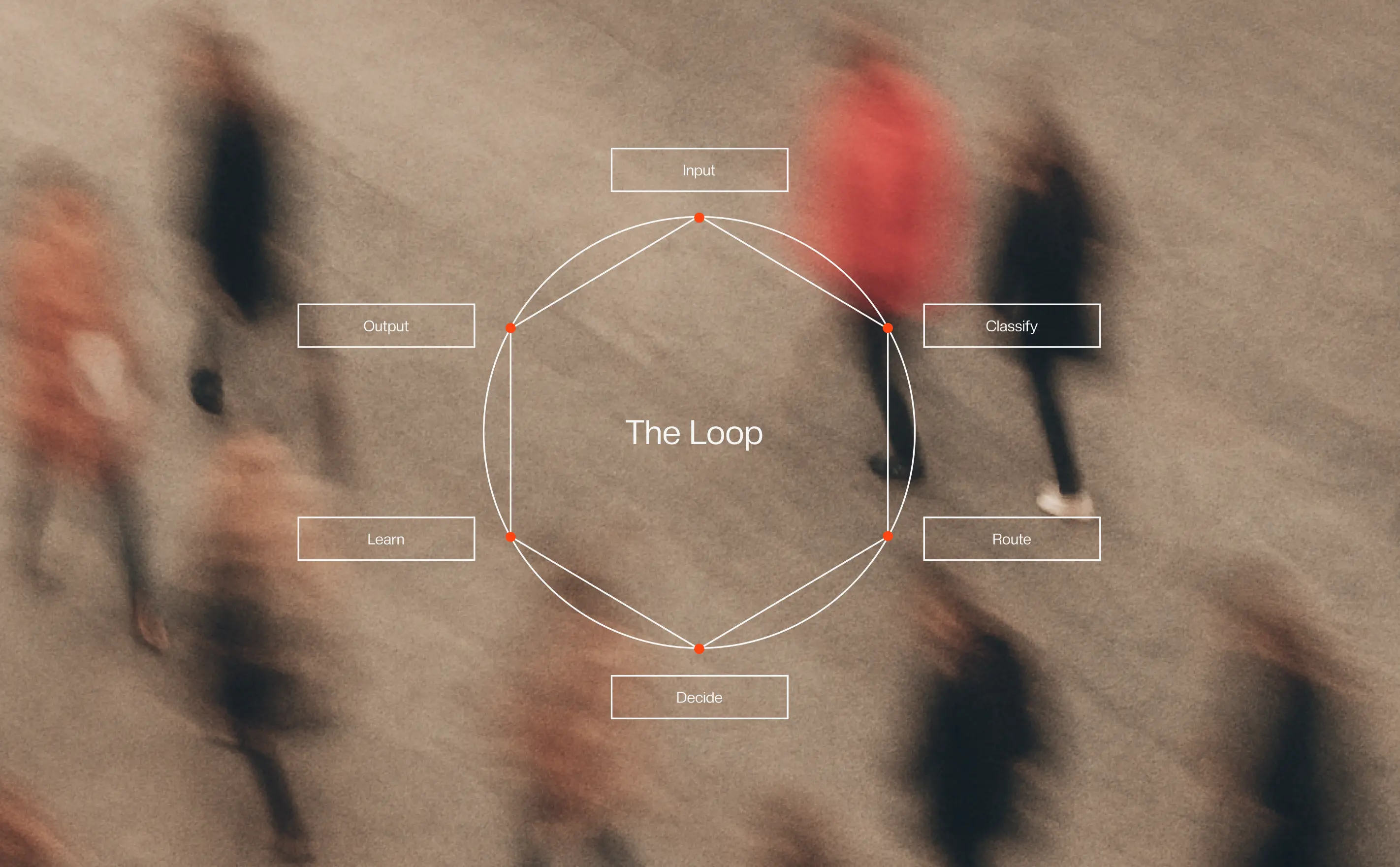
The metrics that actually matter
Beyond accuracy scores, a healthy feedback loop reveals itself in more honest signals: correction rate decreasing over time for the same users, fewer regeneration requests before acceptance, shrinking edit distance, lower abandonment rates, faster time to proficiency with new users or domains.
The most meaningful signal of all is the correction rate decreasing for the same users over time. It means specific people are encountering fewer misalignments. Not that the system is performing better on abstract benchmarks, but that the humans who actually work with it every day need to intervene less. That’s the loop closing.
The human side of the loop
For a feedback loop to actually work, users need to feel that their corrections matter. Not in the abstract, but concretely: “I flagged this last week, and now it’s doing it right.” Closing the loop emotionally, not just technically, is what transforms a tool into a collaborator.
Correction fatigue is one of the most corrosive forces in AI adoption. If users have to flag the same mistake repeatedly, they don’t lose faith in AI broadly, they lose faith in this system, specifically. And they should. Ensuring that high-value corrections propagate effectively, and making that visible, is as important as the learning mechanism itself.
There are also harder questions worth sitting with: What happens when human corrections conflict with each other? Should users be able to see what the AI has learned from their input? Is there a risk of over-personalization…AI that becomes so attuned to individual preferences it stops pushing creative boundaries? And when a user’s corrections improve the system for everyone, what does that contribution deserve?
These aren’t edge cases. They’re the design frontier.
Radiance’s answer: The Source®
These are the questions Radiance has been building toward. The Source® is our response to everything described above. It’s a Creative OS designed not just to execute on brand, but to learn it. Every correction a client makes, every override, every preference expressed through use rather than instruction, feeds a system that grows more aligned over time.
The goal was never AI that eventually needs no corrections. It was AI that learns which corrections matter and gets better at knowing when to ask. A system where the humans in the loop aren’t QA testers providing free labor, but genuine collaborators shaping something that becomes more theirs with every interaction.
That’s what a real feedback loop looks like. And that’s what we built.
The next time you correct an AI output, ask yourself: is this system learning from me? It should be.
Radiance is a creative agency powered by The Source® — a proprietary Creative OS that combines AI infrastructure with human creative direction. Built for fast-growing brands, CMOs, and growth teams who need senior-level thinking without the agency drag.
The System That Remembers Everything Your Agency Forgot.

(00)
bright insights
(Bright Insights)