The Mid-Year Read: What Held Up and What Broke

Six months ago, the 2026 forecasts were everywhere. AI would change everything. Brand would matter more. Budgets would stay flat. Agencies would shrink, or expand, or vanish, depending on who you read.
Now we’re halfway through. Some of those predictions held. Some softened. And a few shifts arrived that almost no one called in January. A clear-eyed read on which is which matters more than another forecast, the second half of 2026 is where most CMOs will reset what they thought this year was about.
Here’s what’s still trending, what’s newly trending, and what fell off faster than the consensus suggested.
Still trending: Brand as the top CMO priority
For the second year running, McKinsey’s State of Marketing put brand at the top of the CMO priority list. That hasn’t moved at the mid-year mark. If anything, it’s intensified. As AI-generated content saturates every channel, distinctive brand authority has become genuinely scarce, and the CMOs who saw that coming in January are now operating with a real advantage.
The mid-year nuance: brand investment is no longer being defended as a soft metric. It’s being defended as the only durable asset in a content environment where everything else is infinitely reproducible. CFOs who pushed back on brand spend in 2024 are signing off on it in 2026.
Still trending: AI ambition outpacing AI readiness
Gartner’s 2026 CMO Spend Survey, released in May, found that 70% of CMOs say becoming an AI leader is critical for the year, while only 30% report mature readiness to scale.¹ That gap was the headline of Q1. It is still the headline of Q3.
What’s changed is the framing. In January, the gap looked like a maturity problem that more pilots and more tools would close. By mid-year, it looks like an infrastructure problem. AI gets more useful when the workflow itself is rebuilt around it while adding it to existing processes produces the same output at roughly the same cost. CMOs who spent the first half buying capability are now realizing the capability was never the bottleneck.
Newly trending: Buyers are starting their research inside AI
This one has become impossible to ignore. Buyers are increasingly starting their research inside AI tools before they ever see a website. If a brand isn’t in the model’s synthesis, it isn’t in the consideration set, and most marketing teams have no reliable way to see how AI platforms are representing them.²
The implication is structural. The same content that builds brand authority is the content that earns AI citations. The brands compounding visibility now are the ones treating editorial output and brand strategy as a single investment, not two line items. Expect this to dominate the second half of the year.

Newly trending: The taste correction
A real aesthetic shift is underway, and it arrived faster than most forecasts allowed. Landor’s global ECD has called it “Anti-AI Crafting.” Adobe’s trend report calls it “hybrid craft.” The labels vary; the direction is the same. Audiences are pattern-matching AI-generated visuals and assigning them lower trust. Designers are responding with texture, imperfection, and choices an algorithm wouldn’t make.
The shift is a maturation. The teams producing the most distinctive work in 2026 are using AI to compress production while reserving every visible creative decision for human judgment. The visible part is the brand. The invisible part is the system underneath it.
Fell off faster than expected: The “AI will replace your agency” narrative
A year ago, the dominant prediction was that generative tools would meaningfully reduce the need for creative agency partners. The mid-year reality is more measured. Gartner’s Jay Wilson put it directly in a Digiday interview earlier this year: the honeymoon around AI and agencies is essentially over.³ CMOs reviewing scopes of work in 2026 are not seeing the cost savings their agencies promised in 2025.
The economics underneath that promise are also starting to wobble. Uber’s CTO told The Information in April that the company had burned through its entire 2026 AI coding tools budget in four months, after internally incentivizing AI usage through leaderboards.⁴ Nvidia’s VP of applied deep learning has said publicly that the cost of compute is currently running higher than the cost of the employees AI was meant to replace.⁵ The math everyone modeled in 2025 assumed token prices, infrastructure costs, and headcount savings would line up cleanly. At mid-year, they aren’t.
What CMOs are seeing is that AI bolted onto an existing agency structure produces the same output at roughly the same cost. The promised efficiency lives somewhere else: in a stack rebuilt around AI from the ground up, not retrofitted with it.
Fell off faster than expected: Polished minimalism
The clean, gradient-heavy, hyper-rendered aesthetic that defined a decade of digital design lost altitude with surprising speed. The pattern that once signaled premium now reads as generic, partly because AI defaults to it. Brands still leaning on that visual language at mid-year are starting to look dated against competitors who pivoted toward warmer, more editorial work earlier in the cycle.
What this points to
A pattern emerges when these signals get laid out together. Brand matters more. AI capability matters less than AI integration. The discovery surface is moving toward systems that synthesize rather than retrieve. And the work that cuts through is the work that’s most clearly directed by a human point of view.
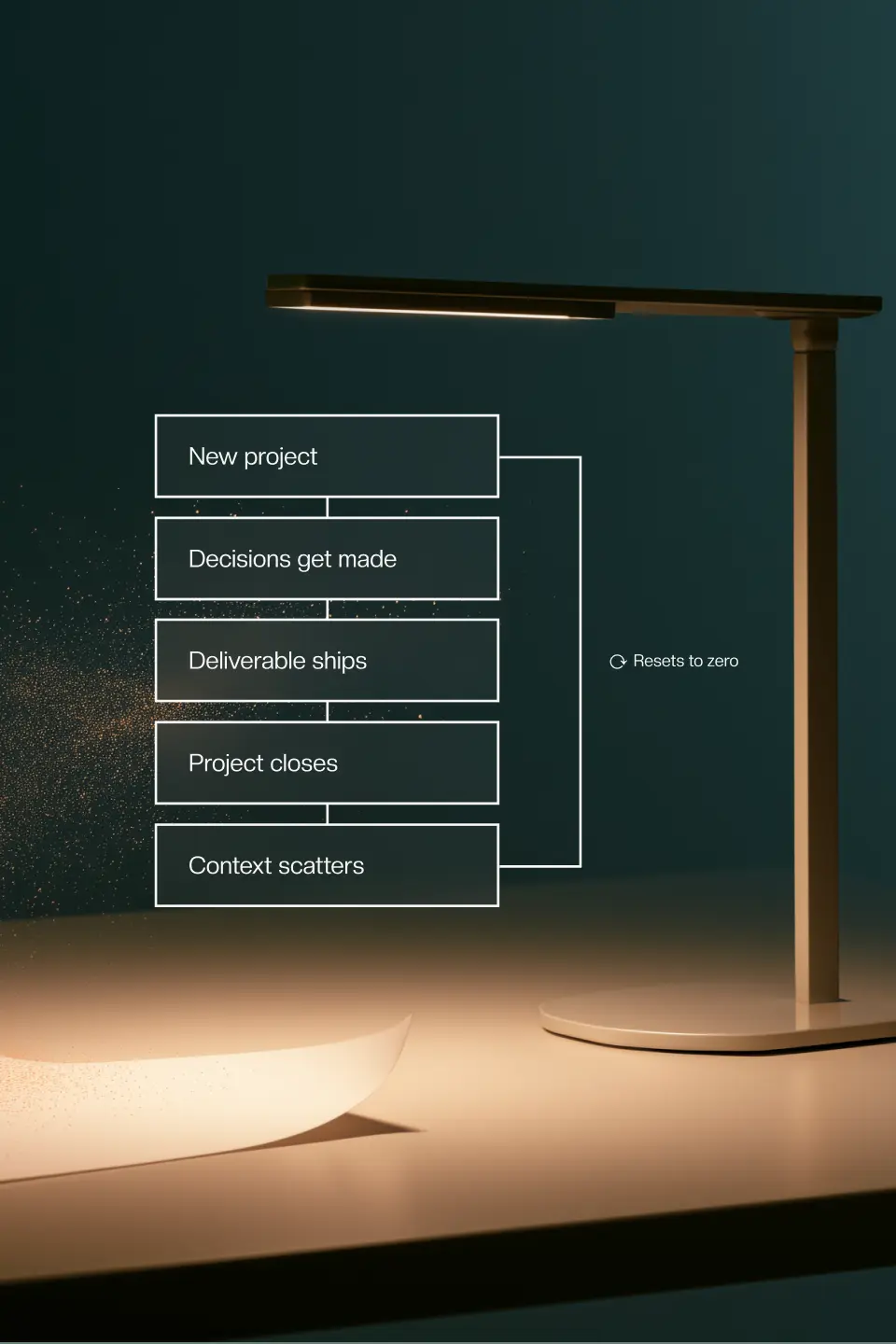
That pattern has an obvious implication for how creative work should be organized. The creative agencies and platforms that win the second half of 2026 are the ones treating brand context as compounding intelligence, not as a deliverable. Every meeting, every decision, every asset either adds to a brand’s accumulated context or evaporates into someone’s inbox.
This month, Radiance took a meaningful step in that direction. The Source® now captures every client touchpoint as living, structured intelligence and acts on it.
- A new Meeting Notetaker joins client calls across Google Meet, Zoom, and Teams, transcribes them, and ties every decision to the right project.
- A new Brand Guidelines Generator turns a brief, a palette, and a handful of references into a complete 26-slide brand deck rendered directly in Figma, with positioning, voice, and art direction in a single guided pass.
- In-platform messaging keeps conversations sitting next to the work they’re about.
- A new Accounts module enriches every lead with an AI-generated company summary the moment it enters the system, so no relationship starts cold.
- Two-way Jira sync, native Figma and Google Drive integrations, and a clearer onboarding path round out the foundation.
The direction is a creative OS that doesn’t just store a brand’s history, but actively works on it: auto-summarizing meetings into action items, turning presentations into living guidelines, and growing a creative intelligence layer that compounds with every project.
What the back half asks of CMOs
The forecasts were a useful starting point. The midpoint is where the harder thinking happens. Every CMO heading into Q3 is sitting on the same question: does the structure of the marketing function, the agency relationships, the tools, the content engine, fit the version of 2026 that actually showed up?
The second half is shorter than it looks. The teams treating brand context as a compounding asset will spend it differently than the teams still treating it as a document.
Sources:
⁵ Axios, interview with Bryan Catanzaro, VP of Applied Deep Learning, Nvidia, April 2026.
The CMOs who reset in Q3 will be the ones who matched their structure to the year that actually showed up. If that’s the conversation you’re having internally, we should talk.

(00)
bright insights
(Bright Insights)