The Brand Identity System Every Startup Needs (Before They Think They're Ready)

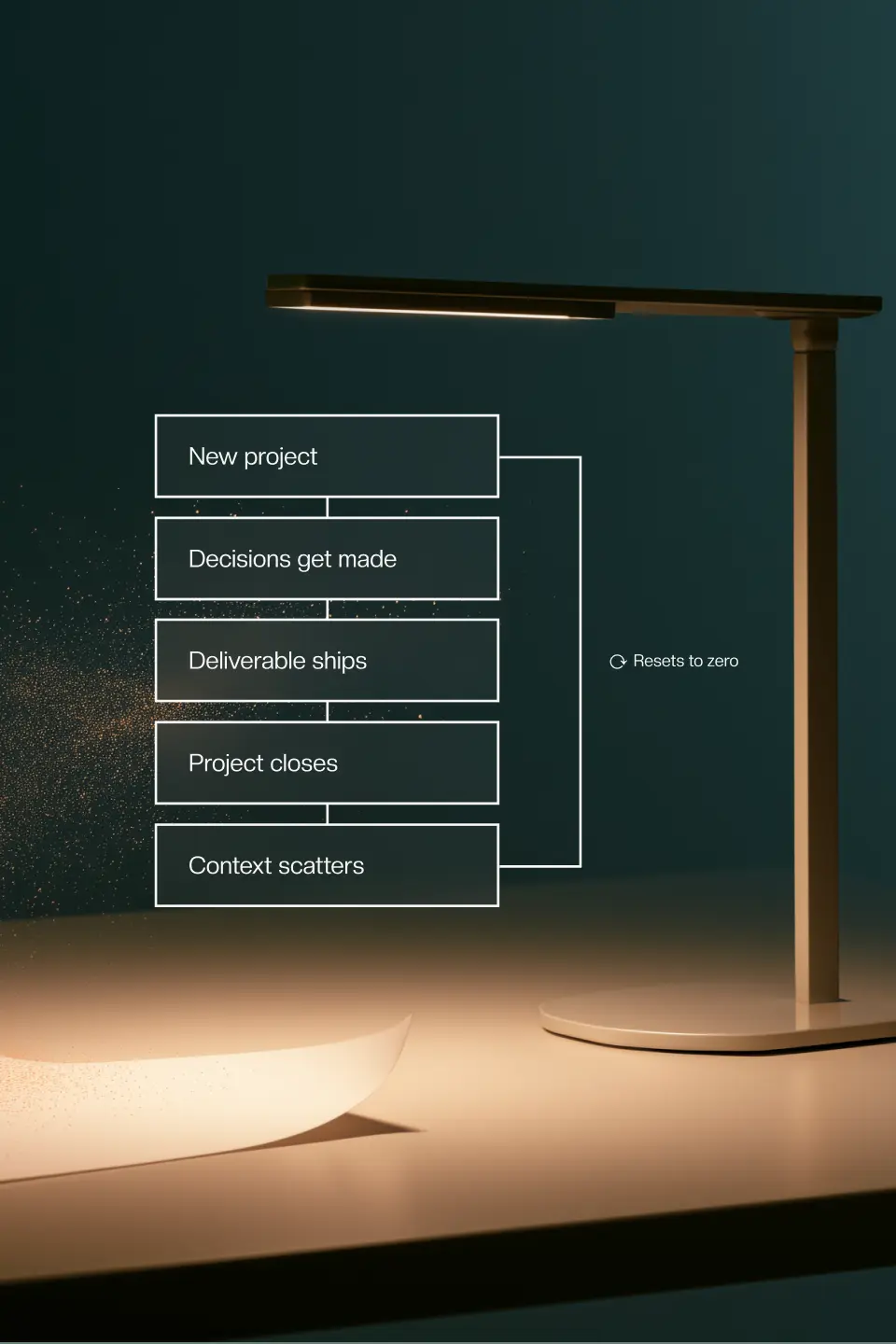
Ask founders when their brand identity became a mess and most can’t answer. Drift accumulates the way most operational problems do, one asset at a time. A pitch deck goes out with an old version of the logo, an investor update carries a color that hasn’t been official in months, and someone on growth ships a paid campaign that reads like a different company wrote it. The website says one thing, the product UI says another, and the Instagram bio says a third.
None of it happened all at once, and that’s what makes it dangerous. Every asset was shipped by someone doing their job under deadline, focused on the part of the business that felt urgent that week. Nobody was careless. Everybody was busy, and busy is the default state of every startup that’s actually working.
By the time anyone notices, the job in front of the founder is a reconstruction project on a brand that never fully existed in the first place.
The “we’re not ready yet” logic breaks earlier than founders think
The instinct to defer brand investment used to make sense. Traditional brand development ran twelve to eighteen months, most of it spent in rounds of review before anything shipped.¹ For a seed-stage company moving in weeks, not quarters, that timeline alone made waiting feel rational.
But drift doesn’t wait for a good time. Only 30% of startups develop formal brand guidelines before scaling, and the ones that skip the step spend 10 to 15% of their pre-Series B budgets fixing the resulting drift later.² Meanwhile, 81% of companies struggle with off-brand content creation even when guidelines exist, because a document sitting in a shared drive is a suggestion, not a system.³
Consumers are moving in the same direction. Salesforce’s most recent State of the Connected Customer research found that roughly 8 in 10 consumers expect a consistent brand experience across every touchpoint, and 76% will abandon a brand entirely after three or more inconsistent cross-channel interactions inside a single purchase journey.⁴ A startup at Series A has already trained a meaningful cohort of customers to distrust it, and nobody on the team can point to the moment it started.
What a minimum viable brand identity system actually contains
Most founders understand branding well enough in theory. What trips them up is that most brand advice describes the endpoint of a mature identity system, when what an early-stage company actually needs is a starting point simple enough to maintain while everyone’s attention is elsewhere.
A minimum viable brand identity system has five components. Any startup can define them in a working week. What matters is that they exist somewhere the whole team can reach, and that they get referenced by default instead of by memory.
Positioning. One sentence about what the company does, for whom, and why it matters. If different people on the team answer this differently, nothing downstream will be consistent.
Voice. Three to five specific attributes with examples. “Professional” is not an attribute. “Direct, technical, allergic to hype” is an attribute. Voice is the layer that keeps a LinkedIn post and a support email recognizable as the same company.
Visual identity essentials. Logo, primary and secondary colors with exact values, one or two typefaces with weight guidance, a small library of approved imagery. This doesn’t require a full brand book, just enough specificity that two people working independently produce compatible work.
Messaging pillars. Three to five things the company says consistently across channels, because it’s decided they matter, not because someone happened to phrase it that way once.
A single home for all of it. This is where most systems collapse. A PDF in a shared drive isn’t a home. A Notion page nobody updates isn’t a home. The home has to be somewhere the work actually happens, or the guidelines never get referenced when it counts.
That last piece is the one every startup underestimates. It’s also the piece that’s historically been hardest to solve when the team is small and moving fast.

Why the “brand book on a shelf” model was always going to fail
Traditional brand guidelines were built for a slower pace of output. A 60-page PDF made sense when a company produced twenty assets a quarter, most through a single designer, reviewed by a creative director who had the guidelines memorized.
That pace doesn’t exist anymore. A seed-stage startup in 2026 produces hundreds of assets a quarter across paid ads, organic social, email, product UI, sales collateral, investor updates, event materials, and PR. The people producing them are rarely the same people from month to month. Some are contractors. Some are AI-assisted. The creative director who used to hold the brand in their head is either not on payroll yet or stretched across too many surfaces to catch every instance of drift before it ships.
Documents don’t operate. They sit. That gap between having guidelines and following them is why 95% of companies have brand guidelines and only 25 to 30% see them actually followed.⁵ Not because teams don’t care, but because nobody has time to check every asset against a PDF they read once during onboarding.
The alternative is a system that lives inside the workflow itself. Where brand context travels with every brief and every draft automatically. Where new work inherits the last decision instead of starting from a blank page. Where staying on-brand is the default, not an extra step someone has to remember.
What became possible in 2026
This is the shift that changed the economics of early-stage branding. Building a system that operates instead of a document that sits used to require a mid-size marketing organization and a bespoke tech stack behind it.
The Source® collapses that requirement. Radiance’s creative OS captures brand context as living infrastructure, so a startup defines positioning, voice, visual essentials, and messaging pillars once, and has them apply across every asset produced from that point forward. The Brand Guidelines Generator turns a single working session into a complete brand system, rendered directly into the tools the team already uses. Every subsequent brief, deck, ad, and campaign draws from the same source, so the brand compounds instead of drifting the moment nobody’s watching.
For a founder with a small team and a full plate, that’s the real shift. The system does the remembering, so consistency doesn’t depend on any one person catching every asset before it ships.

The harder question for founders
Brand timing used to be a budget conversation. Founders waited until the company had enough revenue or headcount to justify what a real brand investment costs, running on an assumption that waiting itself was free (it never has been).
Every month spent shipping without a system produces another inconsistent asset that lands with a customer, a prospect, or an investor, and each one shifts the perception of the company slightly further from what the founder thought they were building. Because the shift happens gradually, nobody can point to when it started, which is exactly why it gets underestimated.
The better question for founders in 2026 is how early a brand system can be built into the way the company already works, so drift never gets the chance to compound in the first place. Every founder eventually deals with brand consistency. The only variable is whether it’s built in from the start or reconstructed after the fact.
Sources:
Radiance is a creative agency powered by The Source® — a proprietary Creative OS that combines AI infrastructure with human creative direction. Built for fast-growing brands, CMOs, and growth teams who need senior-level thinking without the agency drag.
The System That Remembers Everything Your Agency Forgot.

(00)
bright insights
(Bright Insights)