The Dynamo Problem: Why AI Won't Fix Agencies

In 1890, the electric dynamo (a generator that turns spinning motion into electricity, power you could send down a wire to wherever you needed it) already existed. By every measure of the technology itself, it was ready. And yet for nearly forty years, factories that adopted it saw almost no productivity gain. The economist Paul David documented this gap in a now-famous 1990 paper.² The dynamo wasn’t the problem. The factory was.
Steam-era factories had been built vertically, stacked over multiple stories to keep belt runs short and the central power source close. When dynamos replaced steam engines, owners used them the same way: as a centralized source of power feeding the same vertical building. The marginal efficiency improvements were real but small. The breakthrough came decades later, when factory owners finally redesigned the building itself. Single-story layouts. Independent motors on each machine. Skylights where the line shafts used to be. Once the architecture matched the technology, output exploded.
The creative agency industry in 2026 is somewhere in the 1900s of that timeline. The dynamo has arrived. The factory hasn’t been rebuilt yet.
The creative agency org chart was built for a different era
Walk into almost any creative agency today and the structure is recognizable from twenty years ago. An account team owns the relationship. A project manager owns the brief. A creative director approves the work. Designers and strategists sit one layer below. Information moves between these roles through meetings, decks, slack messages, project management tools and emails. Brand context lives in shared drives and the heads of senior staff.
This was a reasonable design for a pre-AI economy. The bottleneck was always human attention, and the org chart existed to allocate it. Account managers translated client needs into briefs because writing a good brief required experience. Project managers chased status updates because no one else had visibility into the work. Creative directors held the brand in their heads because there was nowhere else to put it.
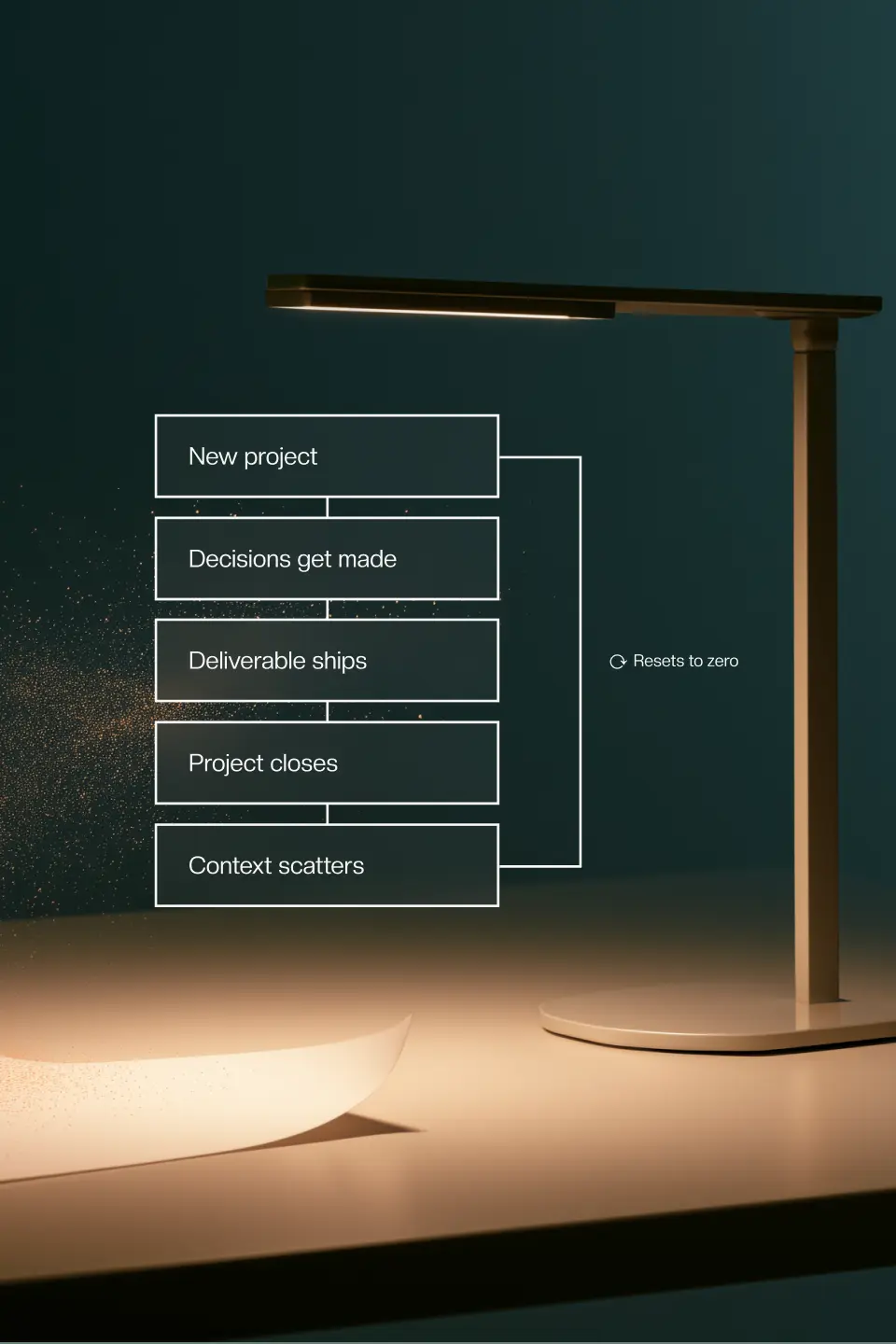
AI changes the cost structure of every one of those functions, and most agencies have responded by inserting AI into the middle of the workflow without rethinking the workflow. A copywriter uses an LLM to accelerate first drafts. A designer uses generative tools to explore directions faster. A strategist uses AI to summarize research. Every individual task gets faster, and the gains stop there. The context from one project doesn’t carry into the next. The brief still gets rewritten from scratch. The brand book still sits on a shared drive. The architecture around the work hasn’t changed, so the work doesn’t compound.
Gartner’s Jay Wilson told Digiday earlier this year that the honeymoon around AI and agencies is essentially over.¹ The reason isn’t that AI underdelivered. It’s that the agency, as a structural unit, wasn’t designed to convert AI capability into client value at scale. The output speeds up. The cost holds. The promise quietly recedes.
The factory that needs rebuilding
The interesting question isn’t whether AI will make agencies more efficient. It’s what a creative organization looks like when it’s designed from scratch around AI as a first-class participant rather than a tool inserted between humans.
A few things shift immediately when that’s the design goal.
Context becomes infrastructure, not a deliverable. In a legacy agency, a brand book is a document that gets produced, delivered, and shelved. In an AI-native organization, brand context is a living system that every asset, brief, and decision adds to. The work isn’t done when the deck is delivered. The work compounds because the deck feeds the system.
Meetings become inputs to the work, not detours from it. A kickoff call in a legacy agency produces notes that someone has to translate into a brief. In an AI-native organization, the meeting itself is captured, transcribed, and tied to the project automatically. The decisions made in the room are available the next time anyone touches the work, without anyone having to remember to write them down.
The account-team layer thins out. Most of what account managers do, translating between client and creative, chasing status, surfacing context, maintaining continuity, becomes infrastructure. The work is no less important. It’s now done by the system instead of performed manually on top of it. What’s left for humans is what humans were always best at: taste, judgment, and direction.
Consistency becomes a property of the platform. Every asset, brief, and decision passes through the same context layer, so drift has nowhere to hide. This is the part most agencies haven’t grasped. Consistency in a legacy model depends on senior creatives catching drift. Consistency in an AI-native model is a property of the platform itself.
This is the redesign; the agency itself, replaced by a different kind of organization.

What this looks like in practice
Radiance has been building this organization from the ground up, and the past month moved it materially forward. The Source® now captures every client touchpoint as living, structured intelligence. A new Meeting NoteTaker joins client calls on Google Meet, Zoom, and Teams, transcribes them automatically, and ties every decision to the right project. A new Brand Guidelines Generator turns a brief, a palette, and a handful of references into a complete brand deck rendered directly in Figma. In-platform messaging keeps conversations sitting next to the work they’re about. A new Accounts module enriches every lead with an AI-generated company summary the moment it enters the system. An open integration layer that connects to the tools clients already work in, including Figma, Google Drive, and project management platforms, rounds out the foundation.
Taken together, this is a different architecture. The work, the context, and the relationship now live in one compounding system instead of scattered across email, Slack, drives, and the memories of whoever happened to be in the room.
That’s what an AI-native creative organization looks like when it’s designed as one. A different category of partner, operating on a different curve.
The harder question for CMOs
The word “agency” carries a lot of structural weight. It implies an account team, a roster, a retainer, a deck cycle, a deliverables list. When CMOs evaluate creative partners, the word itself frames the criteria. Better creative. Faster turnaround. Lower rates. Each criterion assumes the underlying architecture is fixed.
The harder evaluation question for the second half of 2026 is whether the architecture itself is what needs to change. Whether the right partner is a better-organized agency, or a creative organization built on infrastructure agencies don’t have and weren’t designed to develop. The CMOs asking that question are running a different procurement process than the ones still benchmarking hourly rates.
The factory got rebuilt because the people running it eventually realized the dynamo wasn’t a better steam engine. It was a different kind of power. The same realization is overdue in creative services. AI isn’t a faster designer. It’s a different kind of infrastructure. The organizations built around that infrastructure will operate on a different curve than the ones still optimizing the old one.
The dynamo took forty years. The agency category probably won’t get that long.
Sources:
¹ Digiday+ Research, “Agencies punt budget growth expectations to 2027 — while AI worries intensify,” April 2026.
² Paul A. David, “The Dynamo and the Computer: An Historical Perspective on the Modern Productivity Paradox,” American Economic Review, May 1990.

(00)
bright insights
(Bright Insights)