The Most Expensive Thing Your Brand Loses Every Quarter
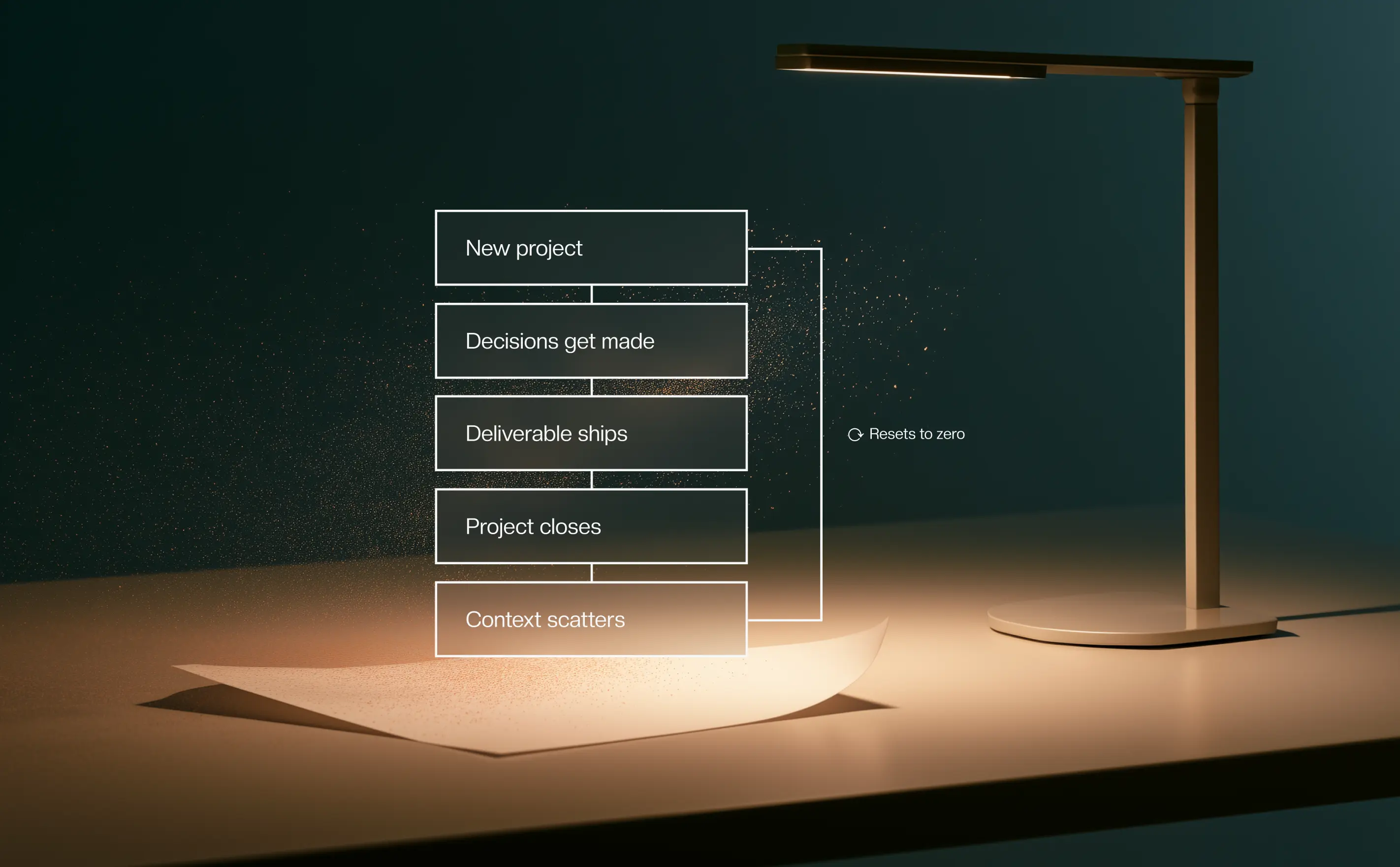
A team kicks off a new project. Someone asks why the brand moved away from a certain look last year, or why a message that tested well never shipped. The room goes quiet. The person who made the call has moved on. The reasoning lived in a deck that is somewhere in a shared drive, or in a Slack thread that scrolled into the past, or in nobody's notes at all. So the team reconstructs the answer, guesses at half of it, and gets to work on a decision that was already made once.
That scene repeats in creative organizations every week, and it carries a real number. APQC's research puts the average knowledge worker at 8.2 hours a week spent looking for, recreating, and duplicating information that already exists, with roughly two of those hours going to rebuilding work the organization has done before.¹
Every quarter, brands lose something that never shows up on a budget line: the accumulated context behind their own decisions. It is the most expensive thing they lose, because everything built on top of it has to be rebuilt too.
Why every project starts from zero
The knowledge does not actually leave the building. It scatters. Each project generates genuine intelligence: what worked, what got rejected and why, what the brand will and will not say. Then the project closes, the team disperses, and nothing in the system is responsible for holding any of it. The next team inherits the outputs, the files and the final designs, without the thinking that produced them. They inherit the answers and lose the reasons.
The instinct is to call this a discipline problem. Better documentation. Tighter file naming. One more wiki that everyone promises to keep updated this time. Those help at the margins and then quietly decay, because the problem underneath them is structural. Creative work is organized around deliverables. An engagement is scoped to produce an output and to end. Every part of the process is designed to ship a thing, and nothing in it is designed to carry the why forward. Memory is nobody's deliverable, so memory is nobody's job.
That is why a change in personnel resets a brand's context to zero, and why the tenth project for a client can feel as cold as the first. The people are capable and the work is good. The architecture around them was never built to remember, so every cycle pays to relearn what the last cycle knew.
The cost you never see on an invoice
The wasted hours are the visible part, and they are already significant. Asana's research on how modern teams spend their time found that the majority of it now goes to what they call "work about work," the searching, the status-chasing, the tracking down of decisions, leaving a minority of the week for the skilled work people were actually hired to do.² A brand paying premium rates for senior creative thinking is often paying that rate for reconstruction.
The compounding cost is worse than the hourly one. When context does not carry forward, brands drift. The same debate gets relitigated three times a year. A visual direction that was deliberately retired quietly returns because nobody remembers retiring it. Voice loosens one project at a time until the brand no longer sounds like itself. New hires and new partners take months to get productive because the knowledge they need to absorb was never written down in a form they could absorb. None of this appears as a line item. It shows up as slowness, as inconsistency, as a brand that feels a little less sharp each year, and it gets absorbed as the cost of doing business.
APQC found that roughly a quarter of a knowledge worker's time is lost to these kinds of drains.³ For a creative team, a meaningful slice of that quarter is spent rebuilding brand context that should have been sitting there the whole time.
What it looks like when knowledge stays
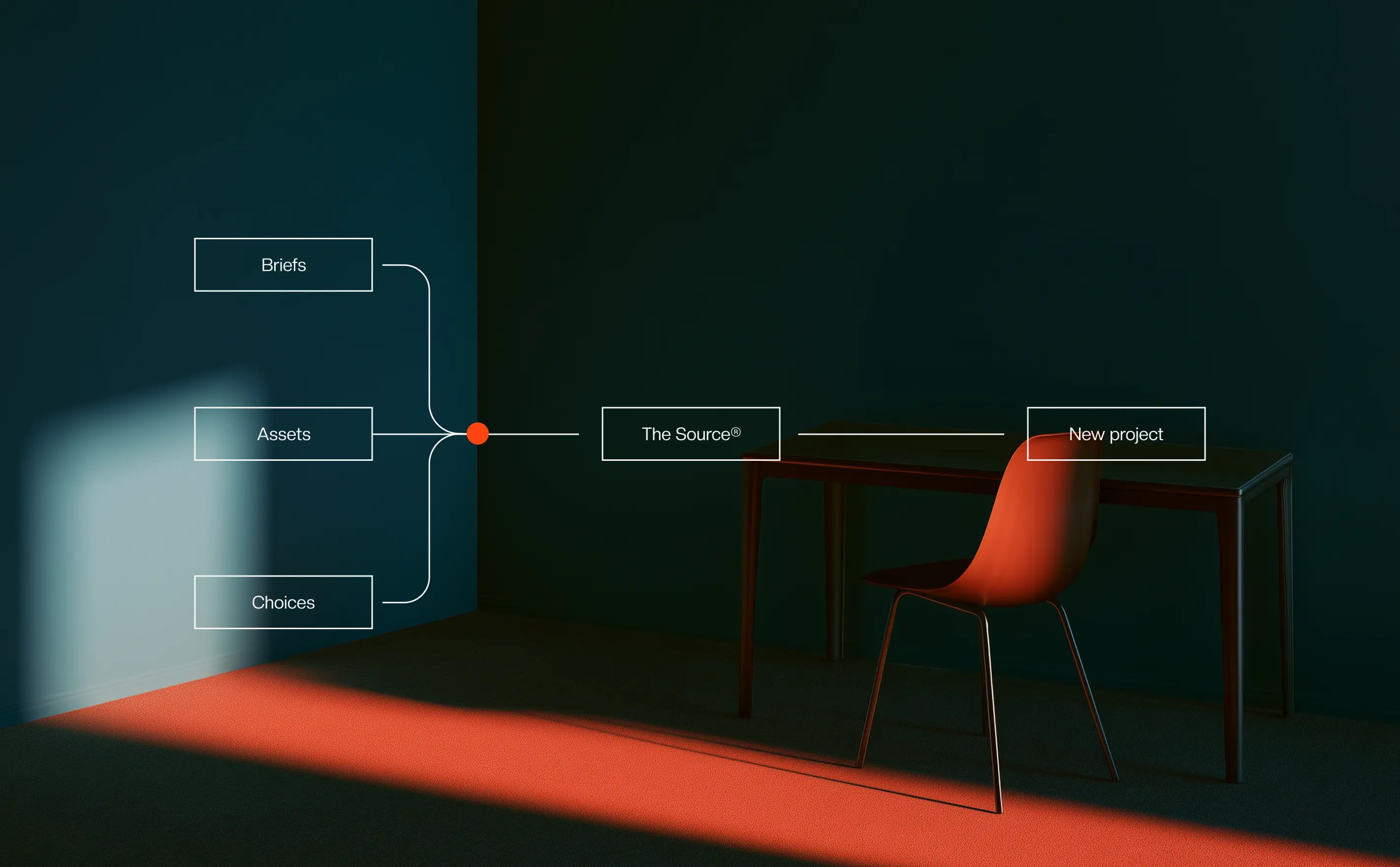
Picture the inverse. A brand's strategy, voice, visual identity, and the reasoning behind its biggest decisions all held in one place as living context; a living system that updates with every brief, asset, and choice. A new team member opens it and understands in an afternoon what used to take a quarter. A returning partner picks up exactly where the last engagement left off. The question "why did we decide this" has an answer that outlives the person who made the call.
In that setup, projects stop starting from zero. Each one begins on top of everything the brand already knows about itself, which means the expensive work goes into what is genuinely new rather than into recovering what was lost.
This is the problem Radiance built The Source® to solve. The Source® holds a brand's strategy, history, and decisions as a persistent context that every project draws from and adds back to, so the knowledge compounds instead of scattering. The brand gets sharper with each cycle rather than a little more diluted. You can see how that works here.

The question worth asking
Most conversations about creative efficiency are about speed. How to produce more, faster, for less. That question has a ceiling, because there is only so much time to compress out of the making.
The better question is why the same context gets rebuilt every quarter in the first place. A brand that answers it stops paying a tax it never knew it was paying, and redirects that spend toward work that moves it forward. The knowledge was always there. The only thing missing was a place for it to live.
Sources:
¹ APQC, "KM Makes Knowledge Workers More Productive and Less Stressed Out," reporting an average of 8.2 hours per week spent looking for, recreating, and duplicating information and expertise, including 2.0 hours recreating work that already exists elsewhere in the organization.
² Asana, State of Work Innovation research, finding that the majority of work time is spent on "work about work" rather than skilled, strategic output (cited in Knowledge Worker Productivity Statistics 2026).
³ APQC, "APQC Survey Finds One Quarter of Knowledge Workers' Time is Lost Due to Productivity Drains."

(00)
bright insights
(Bright Insights)