Can’t Find Anything? It’s saved as Final_Final_v3_REAL.pdf
Don’t ask us what folder your brand book is in. We don’t remember, and neither does anyone else on your team.
There’s a brand guidelines document somewhere in your company. Maybe it lives in a shared drive. Maybe it’s a beautiful PDF with your logo variants, your color palette, your approved typefaces, and a page or two about your “brand voice.” Someone probably spent real money on it.
And it’s probably not being used.
Not because it’s bad, not because your team doesn’t care; but because documents don’t work. They sit, they don’t remember and they don’t adapt. They don’t know what you decided in that Slack thread six months ago, or why you moved away from that tagline, or what your biggest client said about your visual identity on their last call.
This is the hidden cost of the old agency model that almost no one is talking about it.
The Old Model Was Built for a Different Era
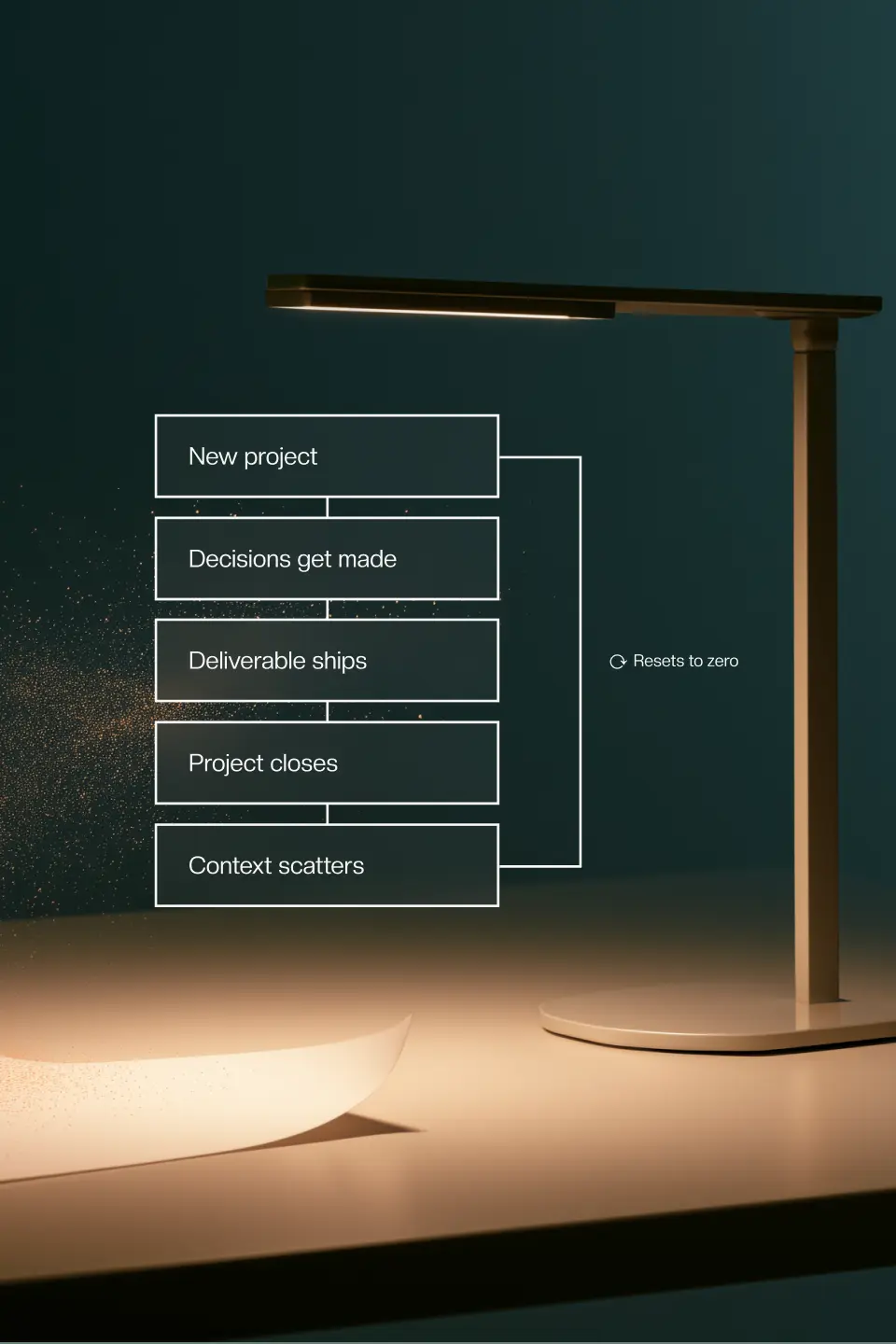
Traditional agencies were built around the project. You hire them, they disappear for weeks, and they come back with a deck. You sign off, you launch, and then…gap. The next time you need creative work, you start over. Context has to be rebuilt from scratch. Your brief becomes a one-way conversation with a team that has already forgotten what made your brand yours.
This worked when the pace of business allowed for it, when a brand refresh happened once every five years. When consistency was something you could enforce with a printed style guide and a quarterly review.
That era is over.
Today, brands are expected to produce and iterate. Constantly. Across channels, markets, teams, and tools. Social one day and pitch deck the next. Campaign assets, web copy, and product packaging are all expected to look and feel like it came from the same mind, even if it came from different people, different tools, and different time zones.
The old agency model doesn’t have an answer for that… It was never designed to.
AI Made the Problem Worse Before It Made It Better
For a moment, it seemed like AI was going to solve everything. Faster outputs, lower costs and creative collateral at scale.
Instead, it surfaced something most brand leaders already suspected: speed without memory is just useless.
AI tools are powerful, but they’re also stateless. Every prompt starts from zero. Every output is trained on the internet, not on your brand. Not on the decisions your team made, the feedback your customers gave, or the strategic pivots that changed your direction. The result is volume without specificity. Creative that looks polished and feels like everyone else.
Generic became the default. Standing out became harder than ever.
The Rise of the Creative OS
When we built The Source®, we weren’t building a faster version of what agencies already did. We were building a different category entirely.
The Source® is Radiance’s proprietary creative OS; a living system that ingests your brand, organizes its intelligence, and activates it across every project, every deliverable, every decision. It’s not a prompt engine. It doesn’t start from scratch. It starts from you.
Here’s what that means in practice:
Every asset, strategy doc, piece of feedback, and creative decision gets ingested into a single source of brand truth. Structured, tagged, and connected so nothing gets lost. No creative designs vanish into Slack, no PDF with brand voicing goes MIA. That foundation powers everything that comes after: briefs get sharper, outputs align faster and revisions drop.
AI agents surface insights rooted in your actual source material not the internet’s. The work that comes out isn’t generic. It’s yours.
When paired with human-lead teams, judgment stays in the loop and taste isn’t automated. The Source® is infrastructure for creative intelligence, not a replacement for it.
What It Actually Looks Like in Practice
When a brand is powered by a living creative system, a few things change immediately.
Onboarding takes days, not months. New team members, new agencies, new partners need to absorb institutional knowledge through osmosis. The system holds it.
Consistency becomes automatic and because every asset is produced from the same foundation, coherence is built in. You’re not enforcing guidelines, you’re working from them.
Creative output gets better over time because the system got richer. More context, more memory, more signal.
And perhaps most importantly: you never have to re-explain your brand again.
Brand Guidelines Aren’t the Problem. The Shelf Is.
Here’s the reframe that changes everything: your brand guidelines are probably fine. The problem is what happens to them after they’re delivered.
They get shelved. And the moment they’re shelved, your brand starts to drift.
The Source® takes brand guidelines off the shelf and turns them into something that operates; something your team actually uses, evolves, and builds with every day. Instead of referencing documents, you work inside the system.
That’s the difference between a brand that looks like something and a brand that functions like something.
The Old Agency Model Is Ending. Adaptive Branding Is What Comes Next.
The agencies that will survive this decade aren’t the ones with the best portfolio. They’re the ones who can answer a question no traditional agency has ever been asked to answer:
What happens after we deliver?
The answer, for Radiance, is The Source®. An ongoing creative system that doesn’t reset when the project ends. That holds your brand’s memory so your team doesn’t have to. That gets better, not just faster.
Creative infrastructure isn’t a nice-to-have. For brands trying to grow in an AI-saturated world, it’s the competitive advantage hiding in plain sight.
Radiance is a creative agency powered by The Source® — a proprietary Creative OS that combines AI infrastructure with human creative direction. Built for fast-growing brands, CMOs, and growth teams who need senior-level thinking without the agency drag.
The System That Remembers Everything Your Agency Forgot.

(00)
bright insights
(Bright Insights)