Digital Darwinism: The Myth of the Threat
Every generation meets a technology it fears.
The printing press. The camera. The internet. Each time evolution accelerates, the story is the same: this will erase what makes us human.
AI is simply the latest character in that long-running myth. But what if we viewed AI as a tool rather than a threat?
Fortunately or unfortunately, history has a habit of repeating itself, and if it teaches us anything, it is that like every powerful tool before it, AI will not diminish human creativity, but instead magnify it.
What we're witnessing isn't the end of originality. It's a sorting. A new phase of evolution where advantage no longer belongs to the biggest, the loudest, or even the most technically advanced, but instead, to those willing to evolve how they think, create, and work.
This is Digital Darwinism.
The Problem: Static While Everything Compounds
Most organizations are paralyzed between two equally dangerous positions.
Some cling to old models, convinced that human creativity alone, without technological leverage, will somehow remain competitive. They're drowning in manual processes, waiting weeks for revisions, burning budgets on redundant tasks, and losing ground to competitors who moved faster.
Others rush headlong into AI adoption without strategy by bolting tools onto broken workflows, automating without understanding, and creating more chaos than clarity. They have ten different AI subscriptions and zero coherent systems.
Both are standing still while the ecosystem shifts beneath them.
The real problem isn't whether or not to use AI: it's that most brands lack the infrastructure to evolve with it. They're stuck working with fragmented partners: a design agency that can't build, a dev shop that can't think strategically, a marketing team that understands neither. It's the fragmentation problem baked into the traditional creative agency meaning: three specialists, one incoherent brand experience.
The cost isn't just inefficiency. It's a compounding disadvantage. While adaptive competitors are learning, iterating, and scaling, you're still explaining the same creative vision to three different vendors who all speak different languages.
The Fear: Losing What Makes You Human
And beneath the tactical paralysis lives something deeper: the fear that adaptation means surrender.
That using AI means your creativity doesn't matter. That building intelligent systems means becoming less human, less original, less you. That automation erases craft, and efficiency kills soul.
This fear is understandable. But it's also backwards.
The truth is: you don't lose humanity by evolving. You lose it by refusing to.
When you're buried in repetitive tasks, you don't have space for creativity. When you're waiting on vendors to translate vision into reality, momentum dies. When every iteration requires weeks of back-and-forth between disconnected teams, your best ideas never make it past the presentation deck.
That's what actually kills creativity: friction, fragmentation, and wasted energy on problems already solved.
The Solution: Creative Infrastructure, Not Fragmented Tools
Survival isn't about strength. It's about adaptability.
In nature, the animals that endure aren't always the apex predators. They're the ones that learn to camouflage, to migrate, to change their feeding patterns when the ecosystem shifts.
In the creative world, this adaptability looks like fluency. The future belongs to the most creative, the most productive, and the most AI-proficient because they've learned how it extends them. It gives ideas room to breathe and scale by removing friction, and thus accelerates execution.
In the AI era, creativity is currency. AI used with intention becomes leverage.
The smartest creators understand this instinctively. They don't replace the human, they enhance the creator. They don't automate everything; they automate the right things. They don't chase tools; they build systems.
True adaptation requires intelligence designed into workflows, decisions, and creative processes from the beginning rather than being bolted on after the fact.
This is the shift from tools to infrastructure. From shortcuts to systems. From reacting to AI to architecting with it.
Our Solution: The Design-Tech Hybrid Model
This is where Radiance breaks from the traditional agency model entirely.
Most agencies pick a side. You're either a design shop that dabbles in development, or a tech firm that treats design as decoration applied at the end. This division creates the exact friction that kills momentum. That split is exactly why so few agencies can answer what is digital product design with anything more than a buzzword.
We exist at the intersection where aesthetic vision meets technical possibility, where brand strategy collides with intelligent systems, where what should exist can actually be built.
A design agency creates the vision. A tech agency makes it functional. But a design-tech hybrid does something fundamentally different: we design systems that think.
When strategy, design, and engineering share the same DNA, you don't lose intent in translation. You don't compromise vision for feasibility. You don't choose between beautiful and intelligent. You build both, simultaneously, because the people conceiving the experience are the same people building the infrastructure beneath it.
Here's How the Hybrid Model Sets You Up for Success:
1. Intelligent Automation, Not Blind Automation
We don't just apply AI tools to your existing processes. We redesign the processes themselves, eliminating bottlenecks, automating repetitive decision-making, and building systems that get smarter over time.
This means:
- Automatic design system updates that propagate across all brand touchpoints
- AI-assisted content adaptation that maintains brand voice while scaling production
- Intelligent quality checks that catch inconsistencies before they reach you
- Workflow automation that routes tasks, manages approvals, and keeps projects moving without constant manual oversight
You're not trading craft for speed. You're removing the friction that was slowing down the craft. The output looks like the digital product design examples worth screenshotting: fast, consistent, and still unmistakably considered.
2. Support That Actually Understands Context
Traditional agency relationships mean waiting for business hours, explaining context repeatedly, and hoping feedback doesn't get lost between meetings.
Our hybrid infrastructure means AI-augmented support systems that digest your feedback continuously, that is trained on your brand, your preferences, your past decisions.
When you submit a revision at 11 PM, you're not shouting into a void. The system processes it, flags dependencies, suggests solutions, and queues implementation, often resolving minor adjustments before you wake up.
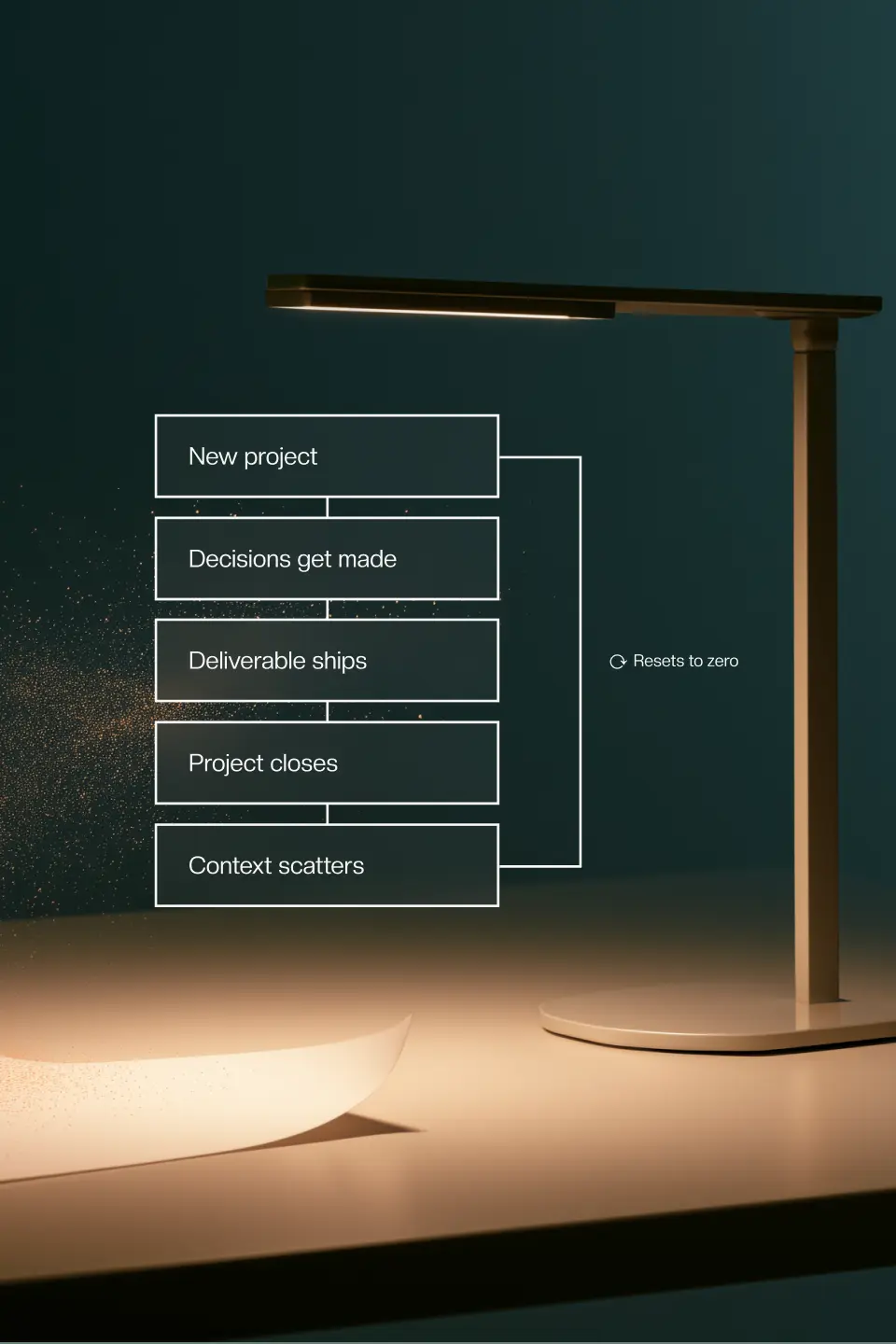
For complex requests, our team receives context-rich briefs instead of starting from zero. No more “can you remind me what we decided last month?” No more re-explaining your vision to different team members.
The system remembers. The system learns. Your partnership compounds intelligence instead of resetting it.
3. Full Transparent Clarity on Every Project
The traditional agency black box where work disappears for weeks and emerges as a surprise reveal does not work in an era that demands agility.
Our design-tech infrastructure means radical transparency by default:
- Real-time project dashboards showing exactly where every deliverable stands
- Automated progress updates tied to actual milestones, not arbitrary status meetings
- Version histories and decision logs accessible anytime that understand not just what was built, but why
- AI-generated project summaries that translate technical progress into strategic clarity
- Predictive timelines that flag potential delays before they become problems
You're never wondering what you're paying for. You're never surprised by scope creep or timeline shifts. You see the work evolving in real-time, with the ability to course-correct continuously instead of catastrophically.
4. One Partner, Zero Translation Loss
Perhaps the most valuable aspect of the hybrid model: you're not managing multiple vendors who don't speak the same language.
Your strategist understands the technical constraints. Your designer knows what the AI can enhance. Your developer thinks in user experience. Everyone operates from the same shared intelligence platform.
This means:
- Ideas move from concept to prototype in days, not months
- No “the design team wants X but engineering says it's impossible”
- No paying one agency to design what another agency has to rebuild
- No creative vision dying in the handoff between disciplines
Evolution becomes automatic. Strategy flows directly into execution. Your brand's intelligence compounds instead of scattering across disconnected partners.
The Real Risk: Staying Fragmented While Others Integrate
Digital Darwinism isn't about adapting later. It's about evolving first.
The winners in this era won't be the ones who resist change or blindly automate everything in sight. They'll be the ones who ask better questions, redesign how work flows, and protect what's human while amplifying what's possible. Increasingly, that means looking less like a vendor list and more like the best digital design agency for the AI era: one integrated system, not three disconnected specialists.
We believe evolution is a creative act. One that deserves intention, taste, and structure. One that requires creative infrastructure, not just creative services.
Because you don't get disrupted by technology. You get disrupted by refusing to evolve alongside it.
A Question Worth Sitting With
So the real question isn't whether AI will change your industry. It already has.
The real question is more personal:
What part of you needs a software update?
At Radiance, we don't just help you adapt to the future. We help you design it.
Be the apex. Not by resisting evolution, but by architecting it.

(00)
bright insights
(Bright Insights)